
Here is a wine that I’ve been drinking for over 20 years.
Montecillo was one of the first Spanish wines that I tasted – along with other notables that were available in Ontario at the LCBO, such as Marqués de Murrieta, Conde Valdemar, Marqués de Riscal, and Campo Viejo.
This was my first foray into Old World Wines.
I was a newbie, who started to understand wine a little bit in the late 90’s, but had no idea what was good, but just wanted something that didn’t burn going down. I was riding the wave of those big, bold, Australian Shiraz wines that reared its (ugly) head in the early 2000s. The LCBO could hardly keep some of them in stock.
I met my buddy Michael Correia in 2008, and he never drank any of the New World stuff (not really), and then we did our Wine Specialist Certification together in 2011. I learned so much about Old World Wines that I almost completely stopped drinking New World.
My New World faves these days rest in the Pacific Northwest of North America … specifically Similkameen, Okanagan, and Willamette Valleys.
Getting back to Old World, specifically Spain and La Rioja, I had a great opportunity in 2011 to visit the region, which really twists and turns between La Rioja, Navarre, and the Basque province of Álava; it was funny seeing the signs change from La Rioja to Álava quite a bit on the drive. They want you to be very clear about where you are!
Driving through, I’ll never forget the first bodega that I drove by; it was for Montecillo in Fuenmayor (see photo below), with their vineyard a 10-minute drive away in Navarrete. I felt special driving through the hilly area and seeing all of the vineyards that I had the pleasure of tasting their wines.
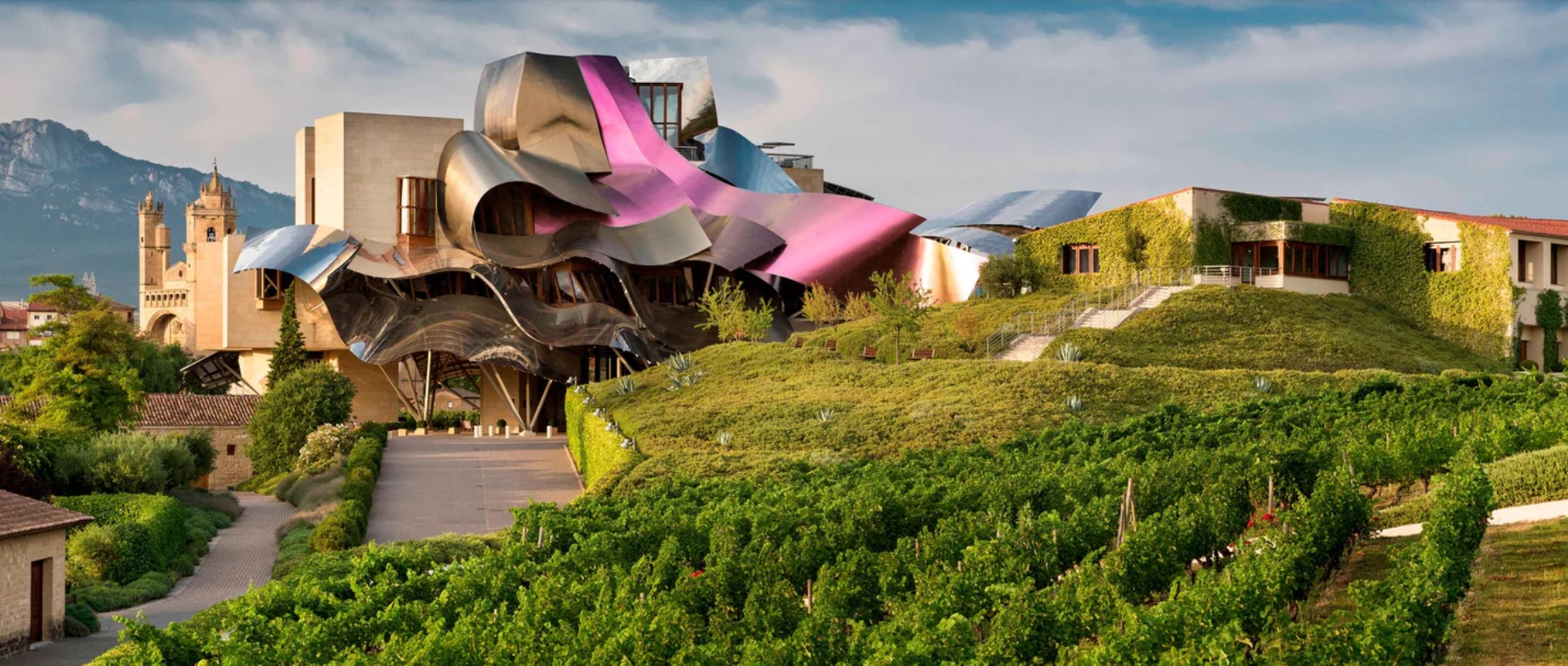
I was stricken, driving north up to Bilbao and seeing the rolling architecture of the Frank Gehry-designed hotel for the Marques de Riscal vineyard. (see photo below)
I should note that 2011 was classified as an “Excelente” harvest. In La Rioja, the harvests are classified as Normal, Mediana, Buena, Muy Buena, and Excelente.
Some other pointers on wines from La Rioja.
You’ll see four classifications on the bottle: Gran Reserva, Reserva, Crianza, and less common outside of Spain, you’ll see Joven (which means young).
For wines labelled Joven, there are no aging requirements. These would be good wines with which to make sangría!
Crianza requires the wine to be aged in the barrel for at least one year in barrel, and another year in the bottle before going for sale.
Reserva wines will need to be in the barrel for at least one year, and then another two in the bottle before release.
Gran Reserva requires the wine to be aged two years in barrel and another three years in the bottle … so, five years before it leaves the vineyard.
One other key item to note.
When the blight “phylloxera” attacked the French vineyards, the Murrieta vineyard in Logroño (the capital of La Rioja) was the first to bring the Bordeaux wine making style to Spain, in essence, making wines from La Rioja a viable alternative to Bordeaux wines, when they were no longer available. The French ended up grafting their vines with American vines to ward off the blight, and then eventually, the rest of Europe ended up in the same position as France. There are only a few places in Europe where you can find pre-phylloxera vines; The Bollinger house in Champagne, wines from Etna in Sicilia, and in Spain, white wines from Rías Baixas.
I believe the only place in the world that you can get original French vines is Chile, as the phylloxera never made it over the mountains from Argentina to Chile.
On to the show:
Wine: Montecillo
Region/Appellation: La Rioja (Navarrete)
Grape(s): Tempranillo
Vintage: 2011
Style: Red
Price: $30
The Visual: Oily viscosity in the glass with medium legs – medium intensity in colour, which was ruby with a garnet-coloured rim.
The Aroma: Dried fruits, Spice, Black fruit, Oak, slightly Vegetable, Olive, Clove, and Tobacco.
The Flavour: Was medium + in intensity, and was medium-bodied. With supple tannins, flavours of Plum, Black Berries, and slightly Herbaceous.
Alcohol: medium at 13.5%.
Balance: The flavours were very well balanced with a medium + finish.
Other notes: Dry – With a very strong structure – already 10 years old, this wine could be cellared for another 10 to 20 years.
A couple of years ago, I opened a ’94 Montecillo for my daughter’s birthday, and it was exceptional. It was also an “Excelente” harvest year!
Food pairing: I believe that I drank this wine on its own. However, it would go well with a myriad of tapas (tortilla, gambas al ajillo, Manchego, Zamorano, olives) or even chocolate.
Final Comments: You can never go wrong with these wines. If you want to pick up a 10 year-old bottle of Rioja, you can typically get it for under $30, and you can always go to the La Rioja wikipedia page to find the harvest classification, and in my case, find out that my 10 year-old bottle came from a “Excelente” harvest.
Dollar for dollar, Spanish wines offer the greatest value, in my opinion.
Cheers – Salud – Salute – Živeli – Prost – Na Zdrowie – Skål – Santé


 Vikas Sharma
Leave a comment